
 Dakota leather shirt, former Weltkulturen Museum‘s collection, Photo Wolfgang Günzel
Return of a Dakota leather shirt to Duane Hollow Horn Bear
In 2021, the Weltkulturen Museum handed over the historical leather shirt belonging to the renowned leader of the Teton Lakota, Chief Daniel Hollow Horn Bear (d. 1913 in Washington), to his great-grandson and successor, Chief Duane Hollow Horn Bear, in Rosebud, South Dakota, USA.
The Weltkulturen Museum acquired the shirt in 1908 in an exchange with the American Museum of Natural History in New York. The AMNH had received it in 1906 as part of a large collection belonging to the New York millionaire, socialist and philanthropist James Graham Phelps Stokes (1872–1960). It was no longer possible to ascertain the circumstances under which the shirt had previously come into the possession of J.G. Phelps. The shirt remained in the possession of the Weltkulturen Museum for 113 years and was on permanent loan to the German Leather Museum in Offenbach for a long period.
Video of Chief Duane Hollow Horn Bear's visit
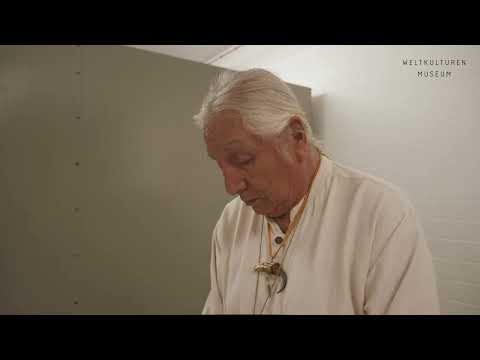
During a visit to the Weltkulturen Museum in 2019, Chief Duane Hollow Horn Bear examined the shirt and made a request for its return. He presented a historical portrait photograph taken by the photographer John Alvin Anderson in 1900, which shows Chief Daniel Hollow Horn Bear (Mato He Oklogeca) wearing the shirt in question. Daniel Hollow Horn Bear was an experienced leader and police chief in Rosebud. As a politician, he repeatedly took part in delegation trips to Washington at the beginning of the 20th century, where he negotiated with the US government regarding improvements for the Indigenous communities on the reservations of that time.
Although it could not be proven that the acquisition of the artefact was unlawful, two facts remain: The shirt was verifiably in the Chief’s personal possession before it entered the Phelps Collection, and he and his entire Indigenous community were forced to endure the repressive, colonial-era conditions prevailing at the time. For Chief Duane Hollow Horn Bear and his family, the return of the shirt is tantamount to the return of his great-grandfather himself. The deerskin shirt, elaborately decorated with glass beads and human hair, bears a family pattern that can also be found on other artefacts belonging to the Hollow Horn Bear family. Furthermore, the Chief’s shirt is an object of religious significance that defines the identity of the Teton Lakota Indigenous community.
During a visit to the Weltkulturen Museum in 2019, Chief Duane Hollow Horn Bear examined the shirt and made a request for its return. He presented a historical portrait photograph taken by the photographer John Alvin Anderson in 1900, which shows Chief Daniel Hollow Horn Bear (Mato He Oklogeca) wearing the shirt in question. Daniel Hollow Horn Bear was an experienced leader and police chief in Rosebud. As a politician, he repeatedly took part in delegation trips to Washington at the beginning of the 20th century, where he negotiated with the US government regarding improvements for the Indigenous communities on the reservations of that time.
Although it could not be proven that the acquisition of the artefact was unlawful, two facts remain: The shirt was verifiably in the Chief’s personal possession before it entered the Phelps Collection, and he and his entire Indigenous community were forced to endure the repressive, colonial-era conditions prevailing at the time. For Chief Duane Hollow Horn Bear and his family, the return of the shirt is tantamount to the return of his great-grandfather himself. The deerskin shirt, elaborately decorated with glass beads and human hair, bears a family pattern that can also be found on other artefacts belonging to the Hollow Horn Bear family. Furthermore, the Chief’s shirt is an object of religious significance that defines the identity of the Teton Lakota Indigenous community.


